
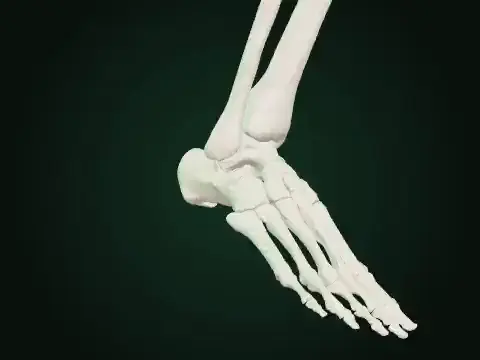
Gastrocnemius, lateral head · BETA
About this resource
The knee is held at30° flexion, matching the CDC requirement of at least30°. Femoral calf origins use the actual posed knee transform. The endpoint is a passive joint reference, not proof that this muscle independently drives or shortens across every angle. The subtalar, midfoot and toe relationships stay neutral. Beyond27.9° plantarflexion the small secondary talar turn stays at0.6° as an authored full-range simplification. The calf–Achilles junction follows a separately authored full-range geometric route; its limited-range share is not a measured contraction law at the full endpoint. The free calcaneal tendon is drawn straight from the heel to the calf junction; that is a display shape, not a solved tendon. Its belly is carried between its two ends, the calcaneal tendon junction and its femoral origin, rather than held by the tibia; that is a display shape. Original native courses and attachment identities remain; skinning and activation do not solve force, tendon strain, contact or constant volume. BETA teaching approximation; no clinical or faculty validation is claimed. Activity and geometric readouts are not muscle-force or patient measurements.
Inspect the selected source model and its visible limitations.
Model & sources
simLAB · original anatomy teaching source
Source-owned teaching illustration, not a clinical measurement. See the player for its scope and sources.